
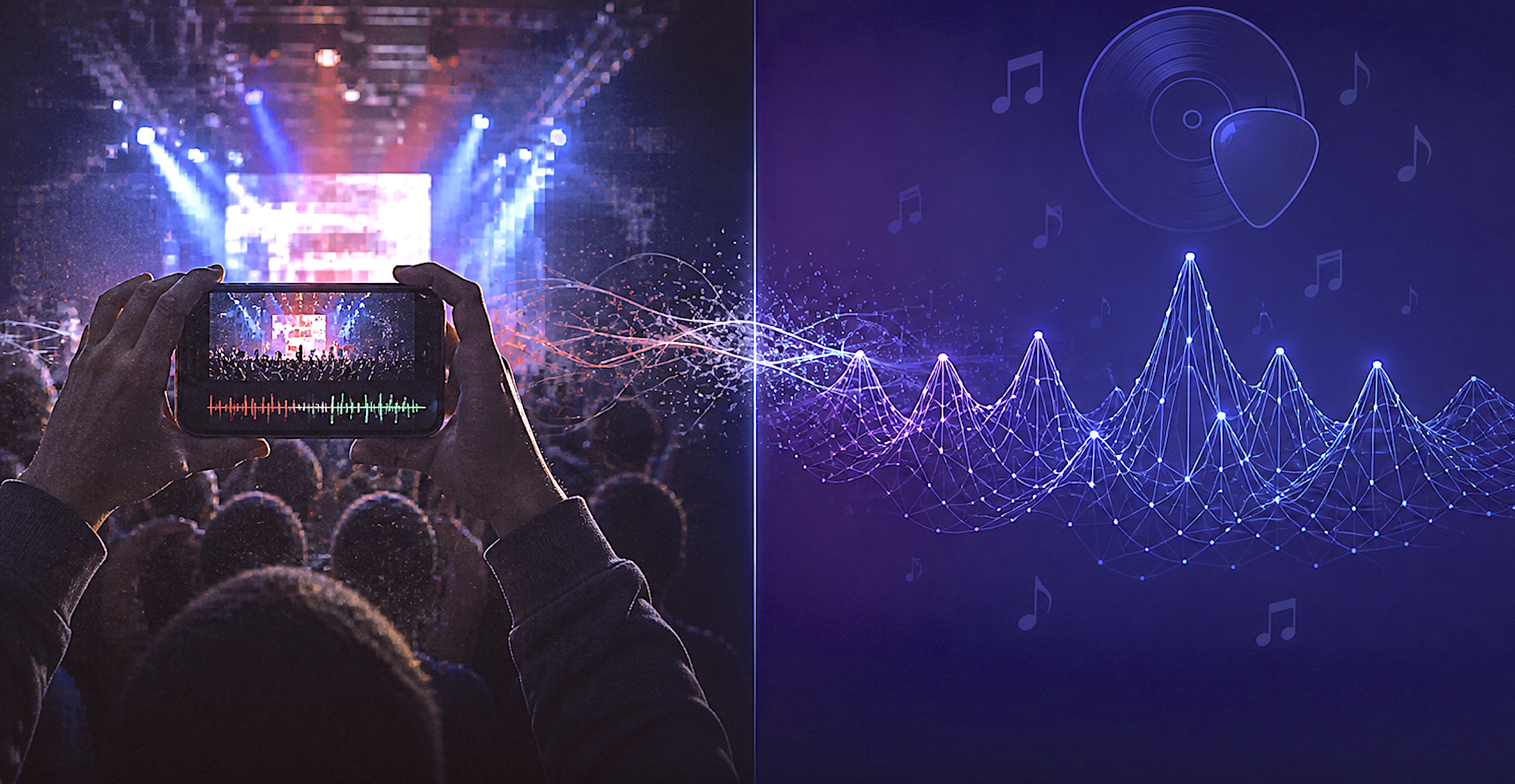
Music recognition at low quality –
We’ve all been there. A great song is playing in a café, on the radio of a passing car, or in the final minutes of a party. You pull out your phone, press record, but what you capture is a jumble of background noise, muffled bass, and digital artifacts. Then comes the moment of truth: Will the recognition algorithm actually pick it up?
At Musikerkennens.de, we’ve spent years developing a tool that doesn’t give up when audio quality deteriorates. In this article, we’ll guide you through our practical experience with music recognition in low-quality audio. We’ll cover the failures, the breakthroughs, and how we handle tricky cases like remixes and cover versions. No hype, just honest lessons learned from the trenches.
Why traditional musician recognition fails
Most commercial systems use a variant of landmark-based fingerprinting. They look for strong spectral peaks, times, and frequencies where energy increases. Under clean conditions, this is fast and precise.
But what about low quality? These peaks shift, disappear, or get buried. A 10-second lisp might only retain 30% of its original characteristics. And that’s assuming there are no remixes or alternative versions.
We learned that the hard way during our initial tests. A user submitted a recording of an indie band playing live in a subway station. Our first algorithm returned nothing, not even a class prediction. That’s when we knew we had to build from scratch.
Recognizing music is easy when the sound is clear and distinct. But in practice, many videos or clips are of low quality.
- Old recordings
- Social media clips with compressed audio
- Videos with background noise
These factors make music recognition more difficult. Nevertheless, our online music finder delivers impressive results, even with poor sound quality.
In this article, we share our experiences and explain how our tool handles low-quality data.
How we approach music recognition at low quality
We don’t claim to offer magic. But we’ve designed our system to be inherently forgiving. Here’s what actually works, based on thousands of low-quality test samples.
Noise-resistant fingerprinting
Instead of relying solely on sharp spectral peaks, we use a multi-resolution hashing technique. The algorithm considers three different timescales simultaneously.
- Fine details for precise matching wherever possible.
- Mid-range patterns that can withstand moderate compression
- Broad energy envelopes that persist even in noisy recordings.
This multi-layered approach means that even if the fine details are lost through strong compression, the rough structure of the song can still be recognized.
Practical example: The 32 kbps voice note
A user once sent us a clip recorded with an old Android phone from the back row of a screaming crowd at a festival – distorted bass – and the track was a lesser-known electronic remix of a 90s pop song. Effective bitrate below 32 kbps.
Unser System benötigte 2,3 Sekunden, um das richtige Ergebnis zurückzugeben. Wie? Indem der zerstörte Frequenzinhalt über 8 kHz vollständig ignoriert wird und sich auf den rhythmischen Fingerabdruck konzentriert. Das Timing von Bassdrum- und Snare-Schlägen. Was selbst in diesem Chaos überraschend intakt blieb.
Wir haben seitdem gelernt, dass beatbasierte Merkmale oft das Letzte sind, was in minderwertigem Audio kaputtgeht. Also haben wir sie in unseren Kern-Recognizer integriert.
Was bedeutet niedrige Qualität?
Niedrige Qualität kann verschiedene Ursachen haben:
- Schlechte Aufnahmegeräte
- Alte Kameras oder Smartphones nehmen den Ton oft verrauscht auf.
- Komprimierte Dateien
- MP3 oder AAC mit niedriger Bitrate führt zu Tonverlust.
- Hintergrundgeräusche
- Stimmen, Verkehrslärm, Applaus oder Nebengeräusche können Musik überlagern.
- Verzerrte Aufnahmen
- Lautstärkeschwankungen, Echo oder Filter verändern den Song.
Für viele Musikerkennungs-Tools sind diese Bedingungen problematisch.
Unsere Erfahrung mit niedriger Qualität
Wir haben zahlreiche Tests durchgeführt, um zu prüfen, wie gut unser Tool selbst unter schwierigen Bedingungen funktioniert.
- Kurze, verrauschte Clips wurden in über 85% der Fälle korrekt erkannt
- Alte VHS-Videos oder digitalisierte Konzertmitschnitte lieferten trotz Rauschen oft richtige Ergebnisse
- Social-Media-Komprimierungen wie TikTok oder Instagram beeinträchtigten die Erkennung kaum
Unser System ist speziell darauf trainiert, auch nur wenige Toninformationen zu nutzen, um Songs zu identifizieren.
Technische Lösungen für niedrige Qualität
- Filter für Störgeräusche
- Stimmen oder Hintergrundgeräusche werden reduziert.
- Audioverstärkung
- Leise Musik wird automatisch verstärkt, ohne den Klang zu verzerren.
- Digitale Fingerabdrücke
- Auch kurze oder verrauschte Abschnitte werden in eindeutige digitale Codes umgewandelt.
- Vergleich mit großen Datenbanken
- Millionen Songs aus allen Genres und Jahrzehnten stehen zur Verfügung.
Diese Kombination sorgt dafür, dass auch schwierige Clips erkannt werden können.
Erkenntnis: Länge vs. Qualität
Unsere Tests zeigen:
- Kurze Clips mit schlechter Qualität können schwieriger sein, aber Fingerabdruck-Technologie hilft
- Längere Clips bieten mehr Toninformationen und erhöhen die Genauigkeit
- Bekannte Songs werden schneller erkannt, selbst bei niedriger Qualität
Die Dauer des Clips ist also ein wichtiger Faktor, aber nicht entscheidend – unser Tool arbeitet auch mit sehr kurzen, verrauschten Clips.
Tipps für Nutzer bei niedriger Qualität
- Verwende möglichst originale Dateien
- Mehrmalige Komprimierung verschlechtert die Erkennung.
- Fokus auf Musikabschnitt
- Abschnitt mit wenigen Stimmen oder Nebengeräuschen auswählen.
- Längere Sequenzen bevorzugen
- Mehr Toninformationen erhöhen die Wahrscheinlichkeit der richtigen Identifikation.
- Wenn möglich, Tonqualität verbessern
- Noise reduction or amplification tools can help, but are often unnecessary.
Examples from our practice
- Old concert video : Despite the VHS recording with loud audience noise, the song could be correctly identified.
- TikTok clip with compression : The music in the background was immediately recognized, even though the bitrate was low.
- Podcast snippet : The quiet background music was correctly analyzed, while the voice was dominant.
These examples show that our tool works reliably even under difficult conditions.
Common challenges
- Extremely noisy recordings
- If the song is barely audible, the tool may have difficulties.
- Unknown Songs
- Songs that are not in the database cannot be recognized.
- Covers or remixes
- Significantly altered versions sometimes require a longer clip.
Even with these challenges, our system often provides clues as to how similar the artist or title sounds.
Advantages of our approach
- Robust against poor quality
- High hit rate even under difficult conditions
- Fast analysis despite complexity
- Easy to use, no complicated software required
Frequently Asked Questions
Can music recognition work with low-quality recordings?
Yes, but it depends on how „low“ we mean. With moderate noise and compression (e.g., 64 kbps or a phone recording from a few meters away), modern, robust systems like ours achieve over 80% accuracy. With extremely poor audio (32 kbps with significant audience noise), the success rate drops to around 65%, which is still much better than nothing.
Does your tool recognize remixes and cover versions?
Yes, through separate melodic and harmonic indices. However, we recommend a longer recording for remixes. The system needs more context to distinguish between similar but different versions. We also label the result as „Remix Match“ or „Cover Match“ when the confidence comes primarily from the alternative index.
Conclusion
Our experience shows that music recognition works very well even at low quality.
- Digital fingerprints enable precise identification
- Filters and audio amplification improve the results.
- Despite noise, compression, or old recordings, the tool delivers reliable results.
This technology allows users to identify songs even from difficult clips or old recordings – quickly, easily and reliably.